
Eaton County Parole Versus Probation
Parole and probation both allow a person to live in the community under stated rules, but they begin in different ways. Parole follows a Michigan prison term. The Michigan Parole Board permits the person to leave an institution while Michigan Department of Corrections jurisdiction continues. Probation comes from a court sentence. In Eaton County, felony probation may be supervised by MDOC, while a local misdemeanor can be supervised through 56A District Court Probation. The court file identifies the sentence that created the supervision.
A jail release does not answer the supervision question by itself. Someone may complete a short county sentence with no supervision, begin probation after a jail component, return to felony supervision from a program bed, or transfer into MDOC custody. OTIS, the Offender Tracking Information System, covers people under MDOC jurisdiction. It does not cover a jail-only sentence. The Eaton court record remains the better starting point for a misdemeanor probation order.
| Feature | Parole | Probation |
|---|---|---|
| How it begins | Release from an MDOC prison under Parole Board authority | A court orders community supervision as part of a sentence |
| Eaton public check | OTIS status, parole date, and assigned field office | OTIS for felony probation; D56A or C56 court record for the order |
| Local contact | MDOC Eaton Parole/Probation Office | MDOC Eaton office for felonies; 56A District Probation for misdemeanors |
| End point | Discharge from MDOC jurisdiction | Court or MDOC discharge after the ordered term |
Verify Eaton County Post-Release Supervision
Start with the legal track, not just the last place the person was held. The Eaton County Jail can house pretrial detainees, sentenced residents, people awaiting MDOC transport, work-release participants, and certain MDOC-linked program populations. Physical departure from that building can lead to very different legal outcomes. Match the name, birth date, case, and custody episode before drawing a conclusion.
- Search the Eaton D56A or C56 court case. Read the disposition, judgment, sentence, probation order, warrant entries, and later orders.
- For a felony prison, parole, or probation matter, search OTIS by last name or the six-digit MDOC number. Confirm identity with the sentencing court and offense.
- Read current status and location together. A field office can indicate community supervision. A prison location means state custody continues.
- Check the Date Paroled, supervision dates, or Discharge Date when shown. An earliest release date is eligibility information, not proof of release.
- Call the office for the correct legal track when the public record is unclear or appears stale. The county misdemeanor office and MDOC office are not interchangeable.
The broader search and release-record sequence is available on the Eaton County released inmates home page. That sequence is useful when the person’s state, county, or federal jurisdiction is uncertain.
Note: OTIS excludes people sentenced only to county jail, so a no-result can be consistent with a valid Eaton misdemeanor probation case.
Eaton County Supervision Office Split
Two supervision offices share the court-complex address at 1045 Independence Boulevard in Charlotte, yet they serve different groups. The MDOC Eaton County Parole/Probation Office handles state felony parole and probation. Its telephone is 517-543-4364. The 56A District Court Probation office handles local misdemeanor matters and uses 517-543-4099. Published district probation hours are Monday through Friday, 8:30 a.m. to noon and 1:00 to 4:30 p.m.
The court and OTIS status determine which office fits. A felony probationer listed in OTIS belongs with MDOC field supervision. A misdemeanor order from D56A points to District Probation. The offices may limit information that is not public, and neither should be asked to guess from a partial name. Have the case number or MDOC number ready when possible.
The Eaton trial courts share the same complex as the supervision offices. D56A is the correct district court for Eaton misdemeanors and felony preliminary stages, while C56 holds the felony disposition and sentence. D56B is a Barry County court and is not an Eaton search route. Confirming that court code is a small step that can prevent a valid supervision order from looking absent.
Eaton Supervision Contacts
MDOC Eaton Parole/Probation Office
1045 Independence Boulevard
Charlotte, MI 48813
517-543-4364
56A District Court Probation
1045 Independence Boulevard
Charlotte, MI 48813
517-543-4099
Monday through Friday, 8:30 a.m. to noon and 1:00 to 4:30 p.m.
The official MDOC Region 7 directory shows the Eaton County office in the state field structure.
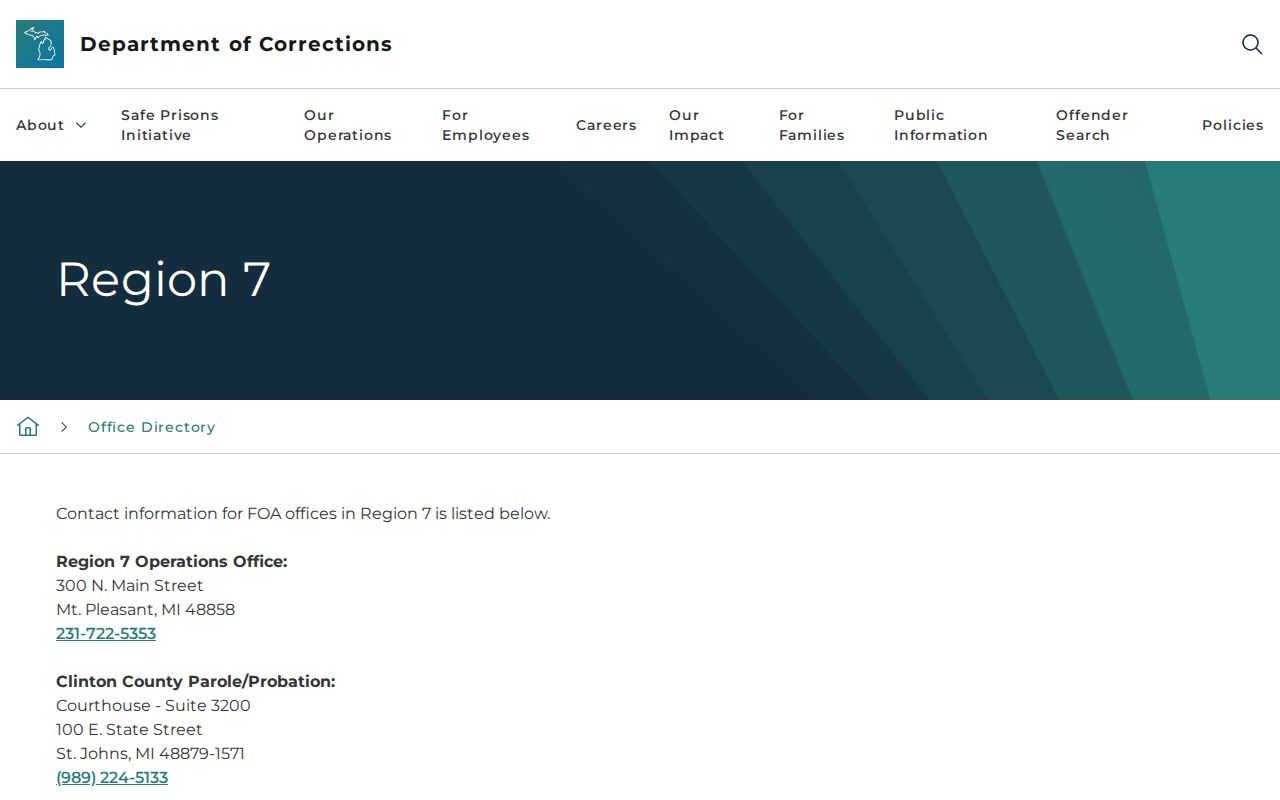
The directory image helps distinguish the state office from the county court’s misdemeanor probation operation.
Eaton Release From WRAP Beds
Eaton County has a local supervision wrinkle. The jail has hosted the Westside Residential Alternative to Prison, known as WRAP, and the Intensive Detention Reentry Program, known as IDRP, under state and county arrangements. WRAP beds have served probation violators. IDRP has operated as an intervention or diversion option for eligible parole violators. A person in one of these beds can be physically inside the Eaton County Jail while still tied to an MDOC case.
Departure from a WRAP or IDRP bed should not be labeled a final discharge without a state record. OTIS and the MDOC Eaton office can show whether the person returned to community supervision, changed status, or moved elsewhere. The county record establishes departure from the building. MDOC establishes the continuing felony supervision status. That division of proof is central in Eaton County because several custody populations share one facility.
Eaton Community Corrections also identifies local court tracks. The county's program overview names Adult Circuit Drug Court, J. Sauter Veterans Treatment Court, Felony Sobriety Court, Swift and Sure Sanctions Probation, and the 56-A District Hybrid Court. Enrollment depends on eligibility and a court order. A program name in a case should be checked against the actual order rather than treated as a universal release condition.
Eaton Parole Absconders and Warrants
An OTIS status of absconder does not mean the person finished supervision. It means MDOC reports lost contact or an alleged supervision failure. OTIS may show the last assigned place, which is not necessarily the person’s present location. MDOC directs information about an absconder to local law enforcement and publishes the Absconder/Escapee Tip Line at 517-755-0855. No official Eaton-specific public absconder list was found.
A court warrant is a separate record. D56A and C56 case entries can show a warrant issued in the related criminal case. A later warrant does not erase a prior jail release event. An active hold during release processing, however, can stop a person from returning to the community. Confirm the warrant with the court or responsible law-enforcement office rather than reading a stale status as current.
Conditions vary by sentence and supervision plan. They can include reporting, approved residence, travel limits, treatment, testing, or other court and MDOC requirements. Public records do not support assuming that one person has every common condition. The signed probation order or parole order controls.
Note: A supervision violation can lead to a hearing, sanction, jail placement, or return to prison, but the result depends on the governing order.
Eaton Release Property and Corrections
The physical aftermath of custody has its own county process. While a person remains in the Eaton County Jail, that person must complete the booking-office form before an authorized third party can collect property. Pickup uses Door 3, the bond lobby, Monday through Friday from 8:00 a.m. to 5:00 p.m. The procedure is not proof of discharge, and the published source does not establish how unclaimed property is handled after final release.
Record corrections also follow the source of the disputed fact. MDOC says sentencing facts generally come from the court. A person disputing that part of an OTIS entry should start with the sentencing court. Questions about current supervision fields belong with the supervising office. This split prevents the jail, court, and field office from being treated as one database.
- Parole
- Community supervision after release from an MDOC prison, with state jurisdiction still active.
- Probation
- Court-ordered community supervision, sometimes after a jail term and sometimes instead of more confinement.
- Absconder
- A supervision status reporting loss of contact or an alleged failure to report, not a discharge.
- Discharge
- The recorded end of the sentence or supervision authority.
Eaton County Supervision Discharge
Supervision ends when the controlling authority records discharge, not merely when a person leaves a jail or prison. For an MDOC case, OTIS may display the discharge date and reason. MDOC generally keeps the public record searchable for three years after discharge. A person beyond that period may no longer appear. A court-approved set-aside can also change public visibility.
For local misdemeanor probation, review the D56A register of actions and any completion or discharge order. The court record is more useful than OTIS because jail-only and local misdemeanor sentences fall outside OTIS scope. For parole or felony probation, compare the OTIS discharge entry with the Eaton office when confirmation is needed. An old parole date proves a past prison departure, but it does not prove supervision has ended.
Michigan VINE can send some custody-change notices, but it is not a supervision discharge certificate. County-jail notices, MDOC general-release notices, and direct-victim parole notices operate as different layers. A notice can help mark an event. The court, MDOC record, or originating office supplies the durable proof.
The Michigan Parole Board is the sole paroling authority for felony offenders committed to MDOC. Public lifer and clemency hearings may be announced individually, while quarterly reports contain aggregate decisions rather than a named-person lookup. A grant can also be suspended or rescinded before departure. For that reason, a hearing notice or favorable decision should be followed by the person’s later OTIS date and status.