
Eaton County Release Paths
A release is one custody event. A discharge can be a later legal endpoint. At Eaton County Jail, a release timestamp shows when the Sheriff stopped holding someone for that episode. It does not always prove the person walked into the community. The person could have posted bond, completed a local sentence, received a dismissal or release order, or moved to another custodian. A state prisoner’s Date Paroled records departure from prison to community supervision. Final MDOC discharge comes later, when state jurisdiction ends.
The Eaton County Corrections Division holds several groups in the same building. They include pretrial detainees, people serving jail sentences, work-release participants, people awaiting MDOC transport, and some residents held under other arrangements. Their next steps differ. Work release means a court-approved daily trip out followed by a return to jail. It is not final release. An MDOC transfer also ends the local booking without ending confinement.
The release route points to the record source. A Sheriff booking and release entry is strongest for a local jail episode. A D56A or C56 court record explains the legal order. OTIS tracks prison, parole, felony probation, and recent state discharge. Federal and immigration systems require their own locators.
| Release path | Meaning | Best next record |
|---|---|---|
| Bond or court order | Local jail hold ends while the case may continue | Sheriff release entry plus the Eaton court order |
| Time served | A county jail sentence reaches its lawful end | Judgment, jail credit, and Sheriff release time |
| Parole | Prison ends, but MDOC supervision continues | OTIS Date Paroled and field-office status |
| Final discharge | MDOC sentence or supervision ends | OTIS discharge data or MDOC discharge record |
| Transfer | Eaton custody ends, but another agency takes custody | Receiving jail, MDOC, BOP, ICE, or court record |
- Time served
- A sentence completed through time already spent in custody.
- Parole
- Community supervision after release from an MDOC prison.
- Probation
- Court-ordered community supervision that may follow or replace jail time.
- Discharge
- The recorded end of a sentence or supervision authority.
- Detainer
- A request or legal hold from another authority that may block community release.
Eaton County Release Record Fields
Eaton County has no public recent-release screen with a fixed set of displayed fields. The useful record is the existing booking, jail-register, or custody entry maintained by the Sheriff. A precise request should identify the person and custody episode, then name the fields needed. Some parts can be redacted because of juvenile rules, medical privacy, security, an active inquiry, protected identifiers, or a sealing or set-aside order.
| Requested field | What it can establish |
|---|---|
| Booked name and booking identifier | Matches the record to the correct person and jail episode. |
| Booking date and arresting agency | Anchors when and how Eaton custody began. |
| Charges at booking | Links the jail stay to a case, though charges can later change. |
| Release date and time | Shows when the local custody episode ended. |
| Release authority or type | May distinguish bond, court order, time served, or transfer. |
| Destination or receiving agency | Can separate community release from continued custody elsewhere. |
| Bond amount, type, and receipt | Connects a bond-out to the related court action. |
| Booking photograph | Identifies that booking event, subject to record-specific review. |
The court file supplies a different kind of proof. Its register of actions can show bond orders, dismissal, disposition, judgment, sentence, probation, warrants, and later orders. The signed order controls the legal result. The Sheriff’s timestamp is still the better record of when physical custody ended.
Why did the person vanish from custody sources? A current-custody view is built to show people still held. Once Eaton County releases or transfers a person, the durable proof moves to the release entry, court case, or receiving system.
Request Eaton County Release Records
Send the request to the Eaton County Office of the Sheriff, Attention: FOIA Request, at 1025 Independence Boulevard, Charlotte, MI 48813. The main number is 517-543-3512. The Records Division uses 517-543-5247 and fax 517-543-2922. Its posted office hours are Monday through Friday, 8:00 a.m. to 4:45 p.m., except holidays. The county also lists a FOIA Specialist at 517-543-2287.
- Identify the person by full booked name, date of birth, and any prior name. Add the booking or case number when known.
- Give an approximate booking and release date. Ask for the booking/intake record, jail register, or custody record for that exact episode.
- Name the fields needed, such as release date and time, release authority, and destination or receiving agency if maintained and disclosable.
- Request the booking photograph as a separate item. Ask for electronic copies and set a fee ceiling or request an estimate.
- Track any partial denial, extension, or fee notice. The county provides forms for a denial or excessive-fee appeal.
The Eaton County FOIA page links the form, public summary, and appeal forms.
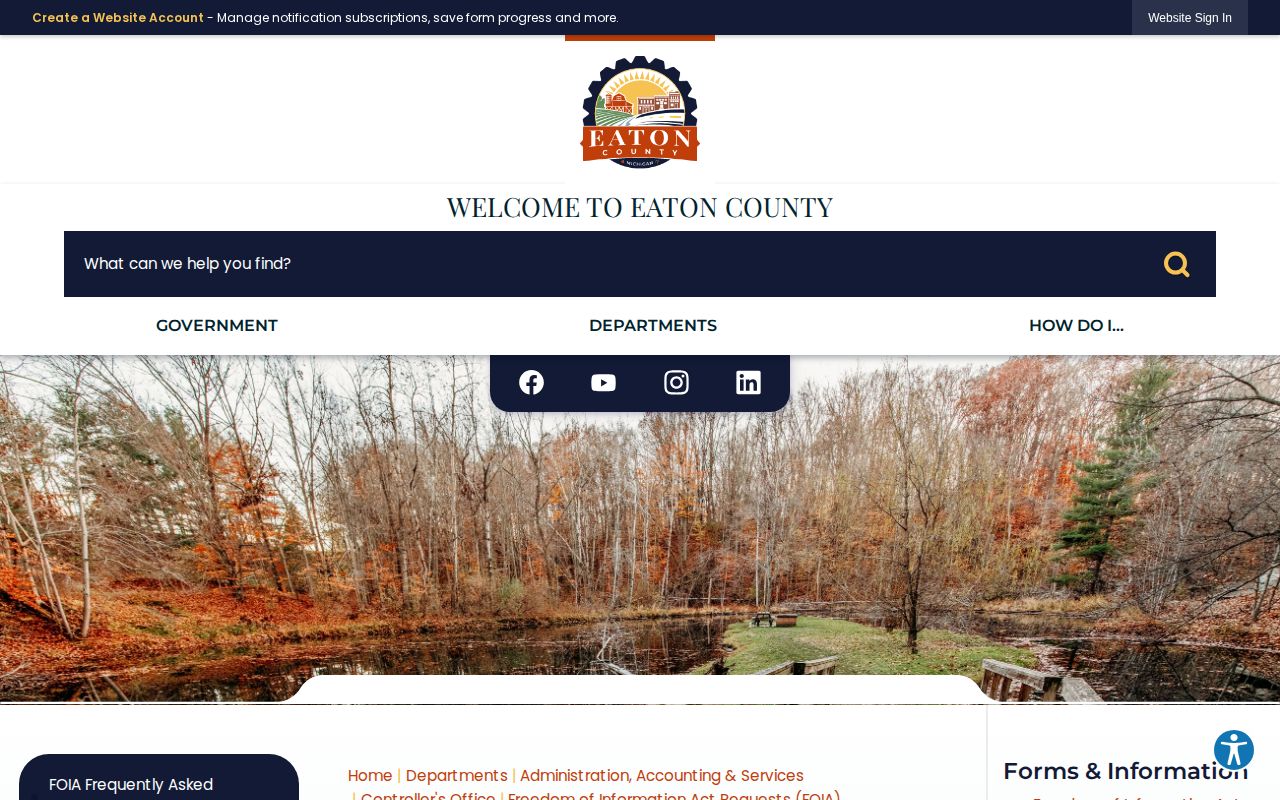
The captured county page confirms the official request route and contact details. FOIA pricing varies by request, so the accident-report fee should not be quoted as a release-record fee.
Eaton County Release Record Law
Michigan FOIA, 1976 PA 442 and MCL 15.231 through 15.246, applies to adequately described existing public records, subject to exemptions. It does not make an agency answer questions or build a special report that it does not keep. Eaton County need not create a new rolling release list. A requester may still seek the underlying release entries for a named person or a precise time range.
Under MCL 15.235, the initial response generally comes within five business days, with a written extension of up to ten more business days. That is a response deadline, not a delivery guarantee.
Fees follow MCL 15.234 and county procedures. A narrow electronic request can reduce search, review, and copy work. If an exemption applies, the office should release reasonably separable public material and identify the basis for what was withheld.
Court records take another route. Michigan’s judiciary is outside FOIA’s definition of a public body. Copies of a judgment, dismissal, bond order, or register of actions must be requested through the court clerk under court-record procedures. Michigan set-aside law can later limit public visibility, and MDOC removes OTIS information when a conviction is set aside or expunged by a court or by law. A later no-result does not prove that no custody episode occurred.
Note: No official Eaton County web-retention period exists for a release list because the county does not publish such a list.
Eaton County Bond Release Door
Door 3 at the Sheriff complex is the documented bond lobby. The walkway lies to the right of the flagpole. An intercom connects a visitor with a jail deputy, and a bond-payment kiosk is available there. During regular county business hours, the April 2026 Inmate Family Guide says bond, restitution, fines, and costs may be paid at the courthouse. The receipt is then taken to the jail bond lobby. The lobby route also serves after-hours bond payments.
Bond-out ends the jail hold, but the case continues unless a court later disposes of it. Match the Sheriff’s release time with the bond or release order in D56A or C56. Do not call Door 3 the inmate exit. Eaton County identifies it for bond and property business but does not publish the door used for physical release, routine release times, or a family waiting area.
Note: A payment receipt supports the bond trail, while the Sheriff release entry confirms when the custody episode actually ended.
Eaton County Release Facility History
The Eaton County Sheriff’s history places operations at the Independence Boulevard complex in July 1989. Inmates moved into the jail in January 1990. A 2006 millage later funded a 142-bed addition. The current Corrections Division reports a capacity of 374. Older county materials use other capacity figures, so each figure must stay tied to its date and source.
These facts explain why several Eaton County custody groups can pass through one hub. They do not prove any one person’s release. For movement through the jail, the booking and release record remains the person-specific source. The 2024 PREA report recorded 3,367 admissions, a year-end population of 166, and an average daily population of 188. Admissions are events, not unique people or release totals.
Eaton County Post-Release Jail Bills
Eaton County states that sentenced jail residents are charged $32 per day and billed after release. Unresolved accounts can enter collection procedures when no arrangement is made. The county lists work-release lodging at $21 per day. The April 2026 Family Guide also discusses post-release billing for certain outside medical costs.
An invoice can help identify a past custody episode, but it is not an official release record. Billing dates may reflect account work after the person left. Use the Sheriff’s release timestamp for the end of local custody and the court judgment for sentence terms. The county’s Corrections Division page is the official source for the jail and listed costs.
The captured Corrections page also explains that a state sentence can move someone from the jail to MDOC. That move is a transfer and needs an OTIS check.
Find Eaton County Released Inmates
A reliable search starts with the custody episode, not a broad name result. Collect the full name, date of birth, approximate arrest date, and any Eaton case or MDOC number. Then use two complementary records when possible. One should explain the legal authority. The other should show the actual custody change.
- Search Eaton’s D56A or C56 court case for bond, dismissal, judgment, sentence credit, probation, warrants, and later orders.
- Contact the Sheriff Records Division or request the booking and release entry. Eaton County publishes no current roster or recent-release feed.
- Search OTIS if an Eaton felony case may have led to prison, parole, or MDOC felony probation. A prison location means continued custody.
- Use MI-VINE for a named-person custody check and future change notice when the participating record is available. Confirm an alert with its source agency.
- Use the sex-offender registry only for a person legally required to register. It is not a list of all released people.
- Check BOP, ICE, or federal court records only when the facts point to that jurisdiction.
- Request Sheriff, court, or MDOC records if portals disagree or an older record has aged out.
A missing name is weak proof. It may mean release, transfer, an alternate spelling, a jail-only sentence outside OTIS, a discharge older than three years, or a set-aside.
The strongest bond confirmation is the Eaton court order paired with the Sheriff release time. State parole is best shown by OTIS Date Paroled and field-office status. Final state discharge calls for OTIS discharge data or an MDOC discharge record. A federal result should be checked for an actual past release date, not just a “not in custody” message.
Eaton County OTIS Release Search
The MDOC OTIS search covers prisoners, parolees, probationers, and people discharged from MDOC supervision during the prior three years. It does not cover people held only in Eaton County Jail or sentenced only to jail. The direct search needs at least a last name or six-digit MDOC number. A unique offender number is the most exact route.
| OTIS field | How it helps with a release |
|---|---|
| Last and first name | Starts a name search; fewer fields help when spelling is uncertain. |
| MDOC number | Provides the strongest exact match for a state-supervised person. |
| Status and location | Separates prison custody, parole, probation, absconder, and discharge. |
| Earliest Release Date | Shows an eligibility boundary, not a promised exit date. |
| Date Paroled | Supports that the person left prison for supervision. |
| Discharge date and reason | Shows when MDOC jurisdiction ended and the recorded basis. |
| Supervision office | Identifies the field office responsible after release. |
Compare the commitment name, birth date, physical descriptors, sentencing court, offense, and MDOC number. A commitment name may not be the current legal name. A field-office location points to supervision. A prison name means the person remains confined even if Eaton County no longer holds them. An absconder status means MDOC reports a supervision problem, not a completed discharge.
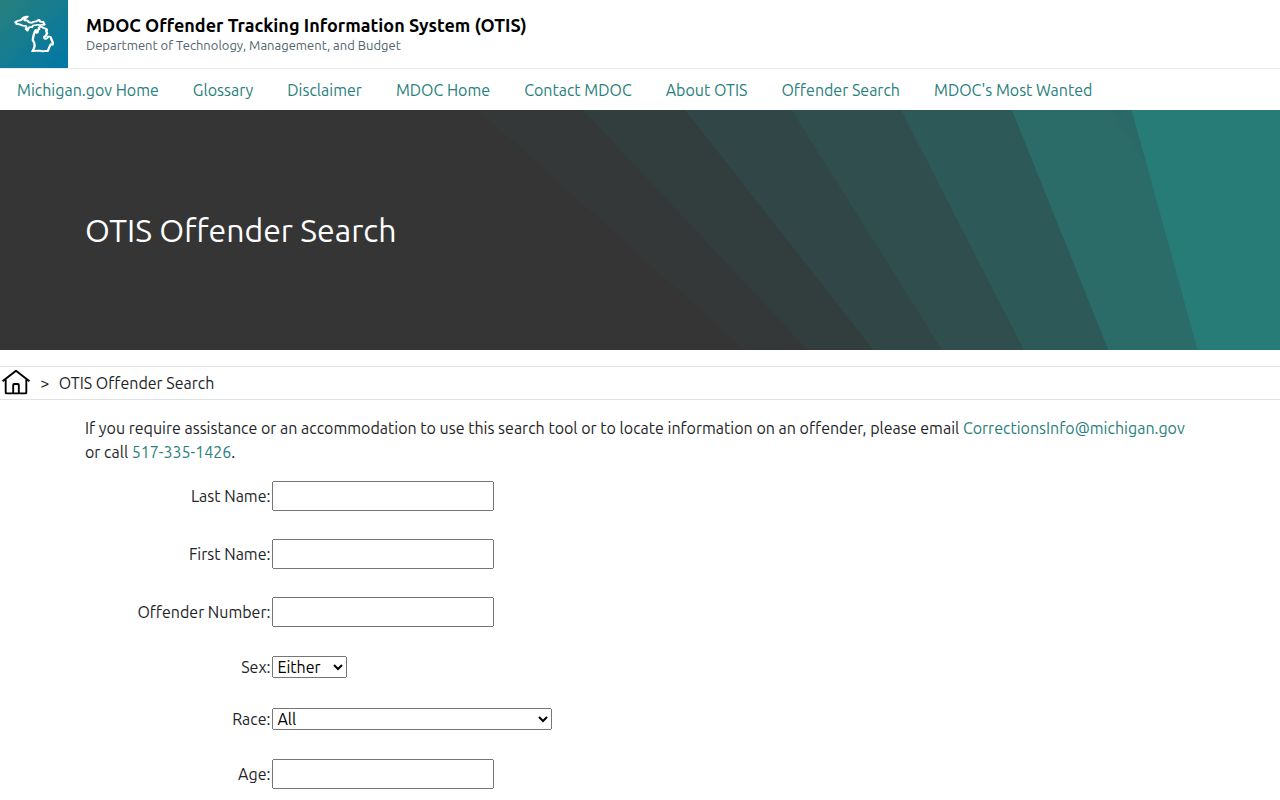
The captured form shows the official name and MDOC-number controls. Result details must still be compared before treating a match as the same person.
Eaton County Release Court Split
Eaton’s court codes matter. D56A is the 56A District Court. It handles adult misdemeanors and the early stages of felony cases, including preliminary examinations. C56 is the 56th Circuit Court and carries felony disposition and sentence records. D56B belongs to Barry County. A valid Eaton release-related case can appear absent when the wrong code is searched.
Use the Eaton Public Case Search gateway to reach the correct MiCOURT court. Search by party or case number. Review arraignment, bond, plea or dismissal, judgment, sentence, probation, warrant, and later orders. A docket is a navigation tool. Request the filed order or a certified copy when exact wording matters.
The county gateway prevents a common court-code mistake. Court records establish legal events, while the Sheriff’s record establishes physical departure from Eaton County Jail.
Note: District court copies follow court procedures rather than county FOIA because Michigan courts are outside FOIA’s public-body definition.
Eaton County MDOC-Linked Releases
Eaton County Jail has housed people in the Westside Residential Alternative to Prison, known as WRAP, and the Intensive Detention Reentry Program, or IDRP. County and state materials tie these populations to MDOC arrangements for eligible probation or parole violators. They are programs or contract populations inside the jail, not separate Eaton facilities.
Physical departure from one of these beds does not always end felony supervision. Check OTIS and the MDOC Eaton County Parole/Probation Office at 1045 Independence Boulevard in Charlotte, 517-543-4364. County records can show when the person left the building. MDOC shows whether the person returned to supervision, entered another state status, or completed jurisdiction. Eaton’s local misdemeanor probation office is different, even though it shares the court-complex address. The Eaton County Parole / Probation page separates those supervision tracks.
Eaton County Property After Release
Property pickup is a separate transaction. A person in jail must complete the booking-office form before another person can collect the property. The authorized pickup then uses Door 3 and the bond lobby from Monday through Friday, 8:00 a.m. to 5:00 p.m. The published procedure does not say that this time equals the custody-release time. It also does not explain every result for property left after final release.
Records can need correction too. If an OTIS issue comes from a court fact, MDOC directs the inquiry to the sentencing court. If the disputed fact concerns supervision, contact the assigned field office. An updated order or direction from the supervising agent is normally what supports a correction. The physical and data trails use different forms, but both depend on the office that controls the source fact.
Can property pickup prove release? No. It can show that the jail approved a property transaction. The booking/release entry is the source for the end of custody.
Eaton County Release Notifications
Michigan’s MI-VIN service, delivered through VINELink, provides custody information and change notices for participating records. Search a name or offered identifier, compare the reporting agency and identity details, then read the reported status. A release notice supports the timeline but is not a release certificate. VINE may lag its source. A no-result does not prove release, and a transfer alert must not be described as return to the community.
Phone, text, and email notice options may be available. Phone registration uses a four-digit PIN. Enter the PIN followed by the pound sign during the automated call to confirm receipt and stop repeats for that event. Text and email do not use that phone PIN. Direct victims who need added MDOC parole notices use the separate MDOC Crime Victim Notification Unit.
Federal custody sits outside VINELink. The BOP Inmate Locator can show a federal release date and a Released location for people within its coverage. “Not in BOP custody” alone does not identify where the person went. The ICE Online Detainee Locator is the right check when immigration custody may follow the Eaton episode. No BOP prison or ICE detention center was found in Eaton County.
A federal pretrial person may instead be held or moved by the U.S. Marshals Service. USMS has no public released-prisoner name search like BOP. Use the federal court docket for the release or detention order, then seek a specific USMS record when needed. Identify the person, federal case and district, date range, and requested disposition. For a disputed state discharge, MDOC’s FOIA process can be used to request a discharge certificate or time-computation record with the full name, birth date, and MDOC number.
Eaton County Release Source Match
Each system answers a narrow question. Choosing the right one prevents a transfer from being mistaken for community release. It also prevents a current-custody tool from being used as an archive.
- Sheriff booking and release record
- Shows the local jail episode and actual release timestamp. It is also the fallback because Eaton has no public roster or release feed.
- D56A or C56 court record
- Shows the order, disposition, sentence, probation, or warrant that explains the legal path.
- MDOC OTIS
- Shows state prison, parole, felony probation, absconder, and recent discharge status. It excludes jail-only sentences.
- MI-VINE
- Provides participating custody checks and notifications. Its alert should be confirmed with the supplying office.
- BOP or ICE locator
- Applies only when federal prison or immigration custody fits the facts. Neither replaces the Eaton release record.
A released person may still be supervised. A person absent from Eaton County Jail may still be in MDOC, another county jail, federal custody, or ICE custody. The destination field and the receiving system settle that distinction better than absence alone.
Note: The Michigan sex-offender registry applies only to people with a registration duty and cannot establish a specific jail release date.
Eaton County Release Facilities
Eaton County has two locally documented detention facilities, but adult and juvenile routes must remain separate. The Eaton County Jail release page covers the adult county hub, its records office, and its transfer paths. It is operated by the Eaton County Office of the Sheriff at 1025 Independence Boulevard, Charlotte, Michigan 48813. The main number is 517-543-3512.
- Eaton County Jail: Community release is confirmed through the Sheriff release record and D56A or C56 case. A state-prison transfer is followed in OTIS.
- Eaton County Youth Facility: An authorized parent or party must work with the assigned probation officer and Juvenile or Family Court. Public person-level access is restricted.
- Michigan prison system: No operating MDOC prison is located in Eaton County. OTIS is still required when an Eaton felony sentence leads to state custody.
- Federal systems: No BOP or ICE facility was found in the county. Use federal sources only when the case or a detainer points there.
The Youth Facility at 822 Courthouse Drive is a secure juvenile detention and residential site. Adult search steps do not apply there. Confidentiality also means a public released-youth lookup cannot be promised. Facility type comes first in every Eaton County release search.