
Eaton Scheduled Versus Actual Release
A future date is not the same as the date a person leaves custody. For a Michigan state prisoner, OTIS uses the terms Earliest Release Date and Maximum Discharge Date. The earliest date marks the first point at which the Parole Board may have authority to act in an eligible case. It is not an appointment for release. The maximum date is the outside sentence limit shown in the state calculation, subject to lawful changes. Date Paroled is stronger proof that a prison departure actually happened.
Eaton County Jail cases follow another path. A person awaiting trial usually has no sentence-completion date. Bond, dismissal, a new order, or later sentencing may change custody. Someone serving a county sentence has a calculation based on the signed judgment, valid jail credit, and Sheriff records. Work release permits court-authorized daily departure and return. It is not final release each day.
A person can also leave the Eaton jail for MDOC, another county, federal custody, or immigration custody. The local booking ends in each example, but only some outcomes return the person to the community. The destination field and receiving-system record resolve that difference.
Find an Eaton Inmate Release Date
The correct search route follows legal custody. Start with the Eaton case and the person’s present system. Use full name, birth date, case number, booking date, and MDOC number when available. Similar names are common, so a date attached to an unverified name match is not reliable.
- Check the Eaton D56A or C56 court record. Read bond orders, disposition, judgment, sentence, jail credit, warrants, and later amended orders.
- For a jail-only sentence, contact the Eaton County Jail Corrections Division or Records Division for the sentence calculation and actual release entry.
- For a state prison, parole, or felony probation case, search OTIS. Use the six-digit MDOC number for the most exact match when known.
- Open the correct state record and read Current Status, Assigned Location, Earliest Release Date, Maximum Discharge Date, Date Paroled, and discharge fields together.
- Check for another hold, consecutive sentence, Board action, or transfer before treating the displayed date as the day of community release.
- After the event, confirm it with the actual release timestamp, Date Paroled, or discharge record rather than retaining the prior estimate.
Eaton County Jail and Sheriff records are routed through 1025 Independence Boulevard, Charlotte, MI 48813. The main number is 517-543-3512, and Records Division is 517-543-5247. The county does not publish a current-inmate or recent-release name list, so there is no official Eaton online field that can be presented as a county projected date.
The county court search uses two Eaton codes. D56A handles misdemeanors and felony preliminary stages. C56 carries felony disposition and sentence. The signed order matters more than a brief online label when the exact jail term, credit, or release condition is disputed. A certified copy can be requested through the court’s own records process because Michigan courts are outside the county FOIA process.
Eaton State Release Dates in OTIS
OTIS is the Michigan Department of Corrections locator for prisoners, parolees, probationers, and people discharged within the prior three years. It does not include a person whose Eaton case resulted only in county jail. That boundary matters. An empty state search can be fully consistent with a real county incarceration and release.
The search accepts last and first name, offender number, sex, race, age, offender status, and marks or tattoos. The unique MDOC number overrides other criteria and is the best exact route. A result should be checked against the commitment name, date of birth, physical descriptors, offense, and sentencing court. MDOC notes that a commitment name may differ from a person’s current legal name.
| OTIS field | How to read it | Release limit |
|---|---|---|
| Current Status | Prisoner, parolee, probationer, absconder, or discharged | Status may change after the last update |
| Assigned Location | A prison or community field office | An absconder location may be the last known office |
| Earliest Release Date | First lawful parole consideration point when applicable | Not a promise or release order |
| Maximum Discharge Date | Outside sentence boundary in the state calculation | Can be affected by lawful recalculation |
| Date Paroled | Recorded departure from prison to parole | State supervision continues |
| Discharge Date | Recorded end of MDOC jurisdiction | Public OTIS visibility generally lasts three more years |
The official OTIS search shows the name and MDOC-number controls used for a state record.
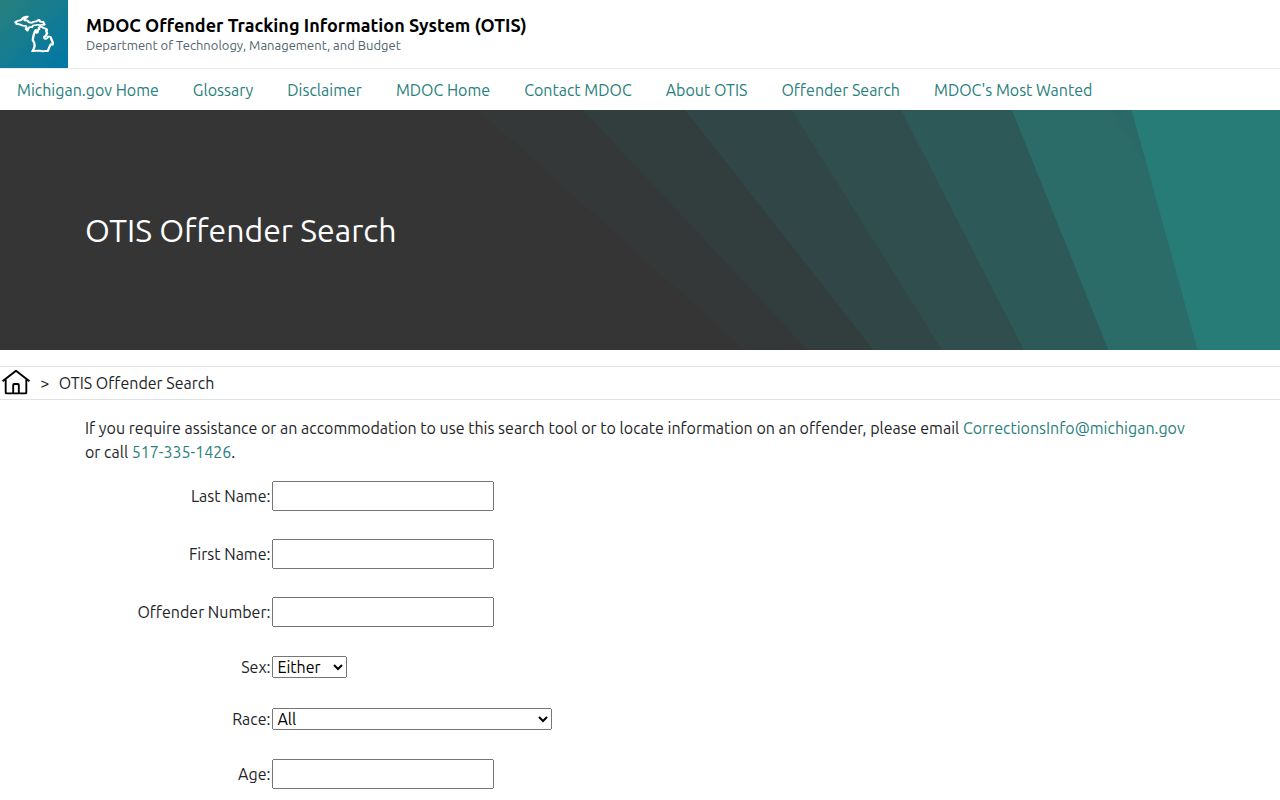
The search screen is for state correctional jurisdiction, so an Eaton jail-only sentence must be checked with county and court records instead.
Note: An office location and Date Paroled can support a community-parole finding, while a prison location indicates confinement continues.
Eaton Release Dates Use Michigan Rules
Michigan truth in sentencing is not an 85 percent rule. For covered newer offenses, the person must serve 100 percent of the judicial minimum prison term before parole consideration. Michigan’s 1998 framework removed good-time or disciplinary-credit reduction of that minimum for covered cases. MCL 791.233, 791.233b, 791.234, and 800.33 work with the offense date and sentence cohort to determine the exact result.
Michigan commonly uses an indeterminate sentence with a minimum and maximum. The court sets those bounds. The Parole Board can gain jurisdiction at the lawful minimum or other controlling eligibility point, but it is not required to release the person then. If parole never occurs, the maximum discharge point may control, subject to the full lawful sentence calculation.
Older eligible sentences can retain statutory good time or disciplinary credits under the governing version of MCL 800.33. That legacy rule must not be applied to every prisoner. The offense date, statute, judgment, and MDOC computation decide whether a credit system applies. Likewise, life sentences do not share one rule. Some are not parole eligible, while others depend on the offense and date.
A favorable Board decision is still prospective. Placement planning, a detainer, misconduct, an unresolved sentence issue, or later Board action may keep the person in custody. Date Paroled and the state status after movement provide better evidence than the eligibility field alone.
Michigan’s 100% Release-Date Rule
The most common shortcut can produce the wrong Eaton County answer. Multiplying a Michigan minimum by 85 percent does not yield a supported release date for a covered truth-in-sentencing case. The controlling concept is service of 100 percent of the judicial minimum before parole consideration. Even then, consideration is not release.
OTIS reinforces that distinction through its labels. Earliest Release Date describes a legal boundary. Maximum Discharge Date describes another. Neither label should be rewritten as a guaranteed projected date. The later Date Paroled field records a past parole event, while Discharge Date records the end of state jurisdiction. Each answers a different question.
Legacy credit cases require close review. Credits can depend on the offense date and the statute then in force. Consecutive sentences can combine terms. An amended judgment can change the source data. Jail credit can alter the computation when lawfully awarded. A reliable answer therefore cites the actual record instead of a percentage borrowed from another state.
Why Eaton Release Dates Change
Release-date movement can arise from the court, corrections system, another agency, or the Parole Board. Some changes move an eligibility boundary. Others do not change the sentence at all but prevent a community departure on the expected day. The record should name which event occurred.
| Factor | Possible effect | Best record |
|---|---|---|
| Amended judgment or jail credit | Changes the sentence inputs | Signed Eaton court order and revised computation |
| Legacy good time or discipline | May alter an eligible older calculation | MDOC time record and controlling statute |
| Consecutive sentence | Extends the combined term | Judgments and OTIS sentence detail |
| Parole grant, denial, or deferral | Changes the likely prison departure path | Board action and later OTIS status |
| Suspension or rescission | Can stop a planned parole before departure | Board and MDOC records |
| Detainer or receiving hold | May cause transfer instead of community release | Jail release entry and receiving agency |
| Data correction | Fixes court-derived or supervision information | Sentencing court or supervising office |
MDOC directs disputes over court-derived sentencing data to the sentencing court. A question about current parole or probation status belongs with the supervising office. Those routes are separate from the Eaton jail’s record of physical departure.
Confirm an Eaton Release Event
For a county bond-out, compare the court release order with the Sheriff’s release date and time. For a county sentence, compare the judgment, credited days, sentence calculation, and actual release entry. For a transfer to MDOC, the Eaton record should identify the departure or destination, while OTIS should show state custody. That transfer is not a community release.
For a parole event, look for Date Paroled and a field-office location. For final state discharge, use the discharge entry or MDOC record. Michigan VINE can provide a custody-change alert when the participating record supports registration, but the alert depends on the source feed and can lag. Registration details are covered on the VINELink Release Check.
Pretrial custody remains less predictable. A posted bond, dismissal, new order, or future hearing can alter the path. Court action can appear before the jail finishes administrative processing. No Eaton source publishes a standard release hour, weekend practice, or exit door, so those details should not be guessed.
Eaton’s published Door 3 instructions concern the bond lobby, intercom, kiosk, and authorized property pickup. They do not identify the door through which a released person exits. During regular county business hours, the April 2026 family guide says certain court payments can be made at the courthouse and the receipt taken to the jail bond lobby. That process can start a bond-out, but the later Sheriff timestamp still proves when local custody ended.
The same care applies to work release. Eaton describes it as a court-authorized daily departure for work followed by a return to the facility. The participant remains in custody until the imposed sentence is completed or another order changes the status. A daily trip should never be reported as final release.
When systems conflict, request the underlying record. A narrow request through the Eaton County Sheriff FOIA route can seek the booking or custody entry showing release date, release time, authority, and destination. A certified court order can establish the legal action. An MDOC records request can seek a release computation or discharge record for a state case. Together, those records distinguish a plan from the event that actually occurred.